A letter from the founder
Why I'm making MakeFont
A letter from Thomas Gnahm, the designer behind MakeFont: a life with type, from the offset press to AI agents, and why everyone who builds should get a typeface of their own.
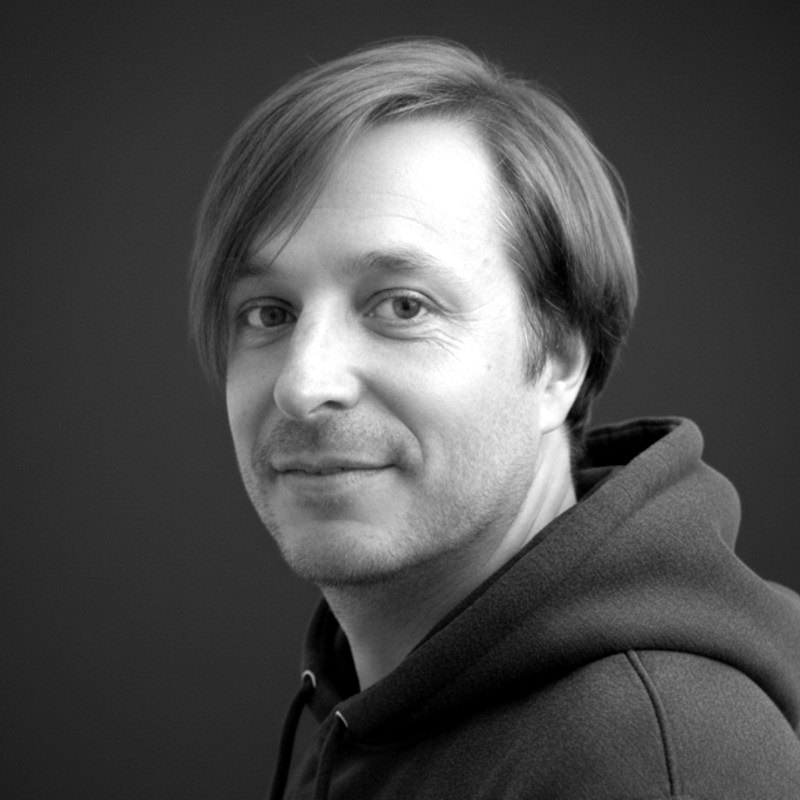
I'm a designer, and type has been my first love for as long as I can remember.
For many years I worked mostly in print: posters for museums, art catalogues, books. With my design studio wirhabenvielvor, which I ran from 2009 to 2018, our work won awards from 100 Beste Plakate, the Art Directors Club and the Deutscher Designer Club, and some of it is in the permanent collection of Die Neue Sammlung in Munich. I spent long hours standing at the printing press with ink on my hands. For some art catalogues, printed in small runs, we mixed the inks right in the running offset press. The colours kept shifting while the sheets went through, so every copy came out a little different. No two were alike.
I studied visual communication at the Bauhaus-Universität Weimar, at Pratt Institute in New York and at EINA in Barcelona, and later taught layout, design patterns and grids in Weimar. I also drew typefaces, at Pratt and in Weimar with Alexander Branczyk, and I met people who make type for a living, like Jan Gerner, known as Yanone.
Then life took me somewhere else for a while. For eleven years I ran Wear It Berlin, a platform and conference for wearable technology, and I led Re-FREAM, a European programme that brought artists, designers and technologists together. With MakeFont I'm closing a big circle. I'm back with type, with letters themselves.
What type has done for us
From the printing press to phototypesetting to the computer, every new technology changed how letters are made. And every time, the way we design and read changed with it. Type has travelled with us through all of it, quietly shaping how ideas look.
What bothers me about the web
In print, type is the main character. On the web it too often plays a supporting role. Google Fonts was a real step forward: it put good typefaces into everyone's hands. But most sites still draw from the same few families, and the sites people build with AI now look more alike than ever.
The digital medium can do so much more.
What AI changes
I love building with AI. Working with Claude Code, Codex and other agents has been a liberation for me as a designer, a gift really: I can make things I used to only sketch. I also see the risks that come with AI, and I think we need to stay critical about where it's heading. But purely as a designer, this moment feels incredibly freeing.
For a long time, a typeface of your own was something only large companies could afford. A corporate typeface takes months of work by people who know the history of letters, the technology and what goes together, and who put their heart into every curve. I have enormous respect for them. And the best part comes afterwards: designers use those typefaces in ways nobody planned, and sometimes they even surprise the type designers who drew them. It's a beautiful kind of teamwork.
MakeFont is not here to replace that tradition. It wants to add to it.
I want everyone who builds something, alone or in a small team, to be able to use a typeface that fits exactly what they're making and that nobody else has. With agents, that is finally possible: practically unlimited typefaces, each made for its purpose. As far as I know, a tool like this doesn't exist yet. That's what makes it exciting, and it's why I'm doing this out of love for type.
Thomas Gnahm
Founder of MakeFont, Berlin
Tell me what you think
I'm curious what you'll make with MakeFont, and I want to make it better. Tell me what works, what doesn't and what you wish it could do. Criticism is welcome.
Every message reaches me directly. Leave your email if you'd like an answer; you can also write to contact@makefont.ai.